Introduction
In today’s digital world, data has become one of the most valuable assets for organizations. Businesses, governments, healthcare institutions, financial organizations, educational sectors, and technology companies generate massive amounts of data every day. However, raw data alone has little value unless it is analyzed and transformed into meaningful insights. This is where Data Analysts play a critical role.
A Data Analyst is a professional responsible for collecting, cleaning, organizing, interpreting, and analyzing data to help organizations make informed decisions. Data analysts use statistical techniques, analytical tools, and visualization platforms to identify trends, patterns, and opportunities hidden within data.
The demand for skilled data analysts has increased dramatically over the past decade. Organizations are investing heavily in data-driven decision-making, making Data Analytics one of the fastest-growing and highest-paying career fields globally.
This comprehensive guide covers everything you need to know about becoming a Data Analyst, including responsibilities, educational requirements, technical skills, salary expectations, tools, certifications, career paths, challenges, and future industry trends.
What is Data Analytics?
Data Analytics refers to the process of examining, cleaning, transforming, and modeling data to discover useful information, support decision-making, and solve business problems. Data analysts convert large amounts of raw information into understandable reports, dashboards, and visualizations that assist organizations in achieving their goals.
Data analytics helps businesses answer important questions such as:
- Why are sales increasing or decreasing?
- Which products are most profitable?
- What customer behaviors affect revenue?
- How can operational efficiency be improved?
- Which marketing campaigns generate the best results?
- What trends are expected in the future?
Without proper analysis, organizations may miss opportunities or make poor decisions based on assumptions rather than facts.
Who is a Data Analyst?
A Data Analyst is a professional who gathers, processes, and performs statistical analysis on large datasets. Their primary goal is to transform complex data into valuable information that supports business strategies and operational improvements.
Data analysts bridge the gap between raw data and business decision-making. They work closely with managers, executives, developers, marketing teams, finance departments, and other stakeholders to provide actionable insights.
Simply put: A Data Analyst turns numbers into meaningful business stories that help organizations make smarter decisions.
Why Choose Data Analytics as a Career?
1. High Demand Across Industries
Almost every industry relies on data today. Whether it’s healthcare, finance, e-commerce, manufacturing, telecommunications, or government services, organizations need skilled professionals who can analyze data and generate insights.
2. Attractive Salary Packages
Data Analysts often receive competitive salaries due to the growing demand for analytical skills and business intelligence expertise.
3. Global Opportunities
Data Analytics is a globally recognized profession. Skilled analysts can work for international companies, remote organizations, consulting firms, and multinational corporations.
4. Career Growth Potential
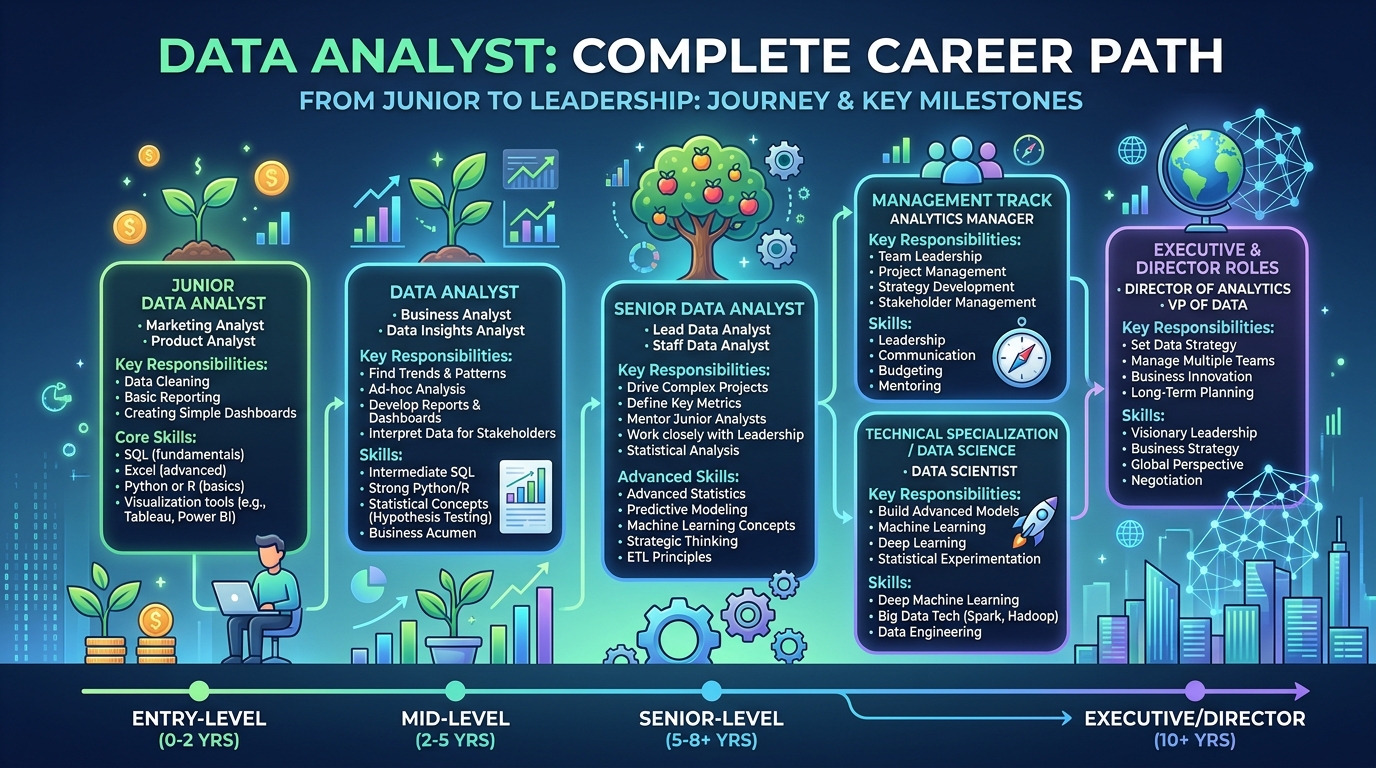
Data analysts can advance into roles such as Data Scientist, Business Analyst, Analytics Manager, Machine Learning Engineer, and Chief Data Officer.
5. Remote Work Flexibility
Many organizations allow data professionals to work remotely because most analytical tasks can be completed using cloud-based tools and collaboration platforms.
6. Continuous Learning
The field evolves constantly with new technologies, analytical techniques, and data platforms, making it an exciting profession for lifelong learners.
Roles and Responsibilities of a Data Analyst
The day-to-day responsibilities of a Data Analyst may vary depending on the organization and industry. However, common duties include:
- Collecting data from various sources
- Cleaning and validating datasets
- Performing statistical analysis
- Identifying trends and patterns
- Creating dashboards and reports
- Visualizing data using charts and graphs
- Supporting business decisions with insights
- Monitoring key performance indicators (KPIs)
- Collaborating with stakeholders
- Presenting findings to management teams
- Automating reporting processes
- Maintaining database quality and accuracy
Types of Data Analysts
Business Data Analyst
Business Analysts focus on improving organizational performance through data-driven recommendations.
Financial Data Analyst
Financial analysts evaluate investment opportunities, budgets, revenues, and financial risks.
Marketing Data Analyst
Marketing analysts study customer behavior, campaign performance, conversion rates, and audience engagement.
Healthcare Data Analyst
Healthcare analysts work with patient data, hospital operations, treatment outcomes, and healthcare performance metrics.
Operations Data Analyst
Operations analysts identify inefficiencies in business processes and recommend improvements.
Product Data Analyst
Product analysts evaluate product performance, user behavior, and feature adoption rates.
Educational Requirements
While there is no single educational path into Data Analytics, most employers prefer candidates with relevant academic backgrounds.
Common Degree Programs
- Bachelor of Computer Science
- Bachelor of Information Technology
- Bachelor of Statistics
- Bachelor of Mathematics
- Bachelor of Economics
- Bachelor of Business Administration
- Bachelor of Data Science
Master’s Degrees
- Master of Data Science
- Master of Business Analytics
- Master of Statistics
- MBA with Analytics Specialization
Technical Skills Required
1. SQL (Structured Query Language)
SQL is one of the most important skills for Data Analysts. It allows professionals to retrieve, filter, update, and analyze data stored in databases.
2. Microsoft Excel
Excel remains one of the most widely used analytical tools for reporting, calculations, pivot tables, and dashboard creation.
3. Python
Python is a powerful programming language used for data manipulation, automation, visualization, and statistical analysis.
4. R Programming
R is commonly used for advanced statistical analysis and research-based analytics projects.
5. Data Visualization
Analysts must be able to present findings clearly using charts, graphs, and dashboards.
6. Statistics
Understanding statistical concepts helps analysts identify meaningful patterns and make accurate predictions.
7. Data Cleaning
Raw data often contains errors, duplicates, and missing values. Analysts must clean datasets before analysis.
Popular Tools Used by Data Analysts
| Tool | Purpose |
|---|---|
| Microsoft Excel | Data Analysis and Reporting |
| SQL | Database Querying |
| Python | Automation and Analytics |
| R | Statistical Analysis |
| Power BI | Business Intelligence Dashboards |
| Tableau | Data Visualization |
| Google Analytics | Website Analytics |
| Looker Studio | Reporting Dashboards |
| Jupyter Notebook | Data Science Projects |
| Apache Spark | Big Data Processing |
Important Soft Skills
- Communication Skills
- Problem Solving
- Critical Thinking
- Business Understanding
- Attention to Detail
- Presentation Skills
- Time Management
- Collaboration
- Decision Making
Salary Structure for Data Analysts
| Experience Level | Average Monthly Salary (PKR) |
|---|---|
| Intern | 20,000 – 50,000 |
| Junior Data Analyst | 60,000 – 120,000 |
| Data Analyst | 120,000 – 250,000 |
| Senior Data Analyst | 250,000 – 500,000+ |
| Analytics Manager | 400,000 – 800,000+ |
| Director of Analytics | 700,000 – 1,500,000+ |
Career Growth Path
- Data Analytics Intern
- Junior Data Analyst
- Data Analyst
- Senior Data Analyst
- Business Intelligence Analyst
- Analytics Consultant
- Analytics Manager
- Data Scientist
- Head of Analytics
- Chief Data Officer (CDO)
Professional Certifications
- Google Data Analytics Professional Certificate
- Microsoft Power BI Certification
- IBM Data Analyst Professional Certificate
- Tableau Desktop Specialist
- AWS Data Analytics Certification
- Microsoft Azure Data Fundamentals
- SAS Certified Data Analyst
Industries Hiring Data Analysts
- Banking and Finance
- E-Commerce
- Healthcare
- Education
- Telecommunications
- Retail
- Government Organizations
- Manufacturing
- Insurance Companies
- Technology Firms
- Digital Marketing Agencies
- Logistics Companies
Challenges Faced by Data Analysts
Although Data Analytics is a rewarding profession, it also comes with challenges.
- Managing large datasets
- Handling incomplete data
- Data privacy concerns
- Meeting tight deadlines
- Understanding business requirements
- Explaining complex insights to non-technical stakeholders
- Keeping up with evolving technologies
Future of Data Analytics
The future of Data Analytics is extremely promising. As businesses generate more data than ever before, organizations increasingly depend on analytics professionals to guide strategic decisions. Emerging technologies such as Artificial Intelligence, Machine Learning, Cloud Computing, Predictive Analytics, and Big Data are expanding the scope of data analysis.
Experts predict that data-related careers will continue to experience strong growth over the next decade. Organizations that successfully leverage data will gain competitive advantages, increasing demand for qualified Data Analysts worldwide.
Tips for Becoming a Successful Data Analyst
- Master SQL and Excel
- Learn Python for data analysis
- Develop strong statistical knowledge
- Build real-world projects
- Create an impressive portfolio
- Learn Power BI and Tableau
- Participate in data competitions
- Practice problem-solving regularly
- Understand business concepts
- Keep learning emerging technologies
Conclusion
Data Analytics has become one of the most valuable professions in the modern digital economy. Organizations across all industries rely on data analysts to transform raw information into actionable insights that improve performance, reduce costs, identify opportunities, and support strategic decision-making.
With excellent salary potential, strong job demand, global opportunities, and clear career progression, Data Analytics offers an exciting future for individuals interested in technology, business, and problem-solving. By mastering analytical tools, developing technical expertise, and continuously learning new skills, aspiring professionals can build successful and rewarding careers as Data Analysts.