Introduction
Marketing plays a crucial role in the success of every business, regardless of its size or industry. Companies invest significant resources into promoting their products and services, building strong brands, attracting customers, and increasing sales. At the center of these activities is the Marketing Manager, a professional responsible for planning, executing, and overseeing marketing strategies that drive business growth.
A Marketing Manager serves as the bridge between a company’s products or services and its target audience. They analyze market trends, understand consumer behavior, create marketing campaigns, manage advertising efforts, coordinate with creative teams, and measure campaign performance. Their ultimate goal is to increase brand awareness, generate leads, improve customer engagement, and maximize revenue.
As businesses increasingly compete in both traditional and digital markets, the demand for skilled marketing managers continues to grow. Organizations across industries require professionals who can develop effective marketing strategies and adapt to rapidly changing consumer preferences.
This comprehensive guide explores everything about becoming a Marketing Manager, including responsibilities, educational requirements, essential skills, salary expectations, career progression, challenges, and future opportunities.
What is Marketing Management?
Marketing management is the process of planning, organizing, directing, and controlling marketing activities to achieve business objectives. It involves understanding customer needs, developing products and services that meet those needs, and promoting them effectively to target audiences.
Marketing managers oversee all aspects of a company’s marketing efforts, ensuring that campaigns align with organizational goals and deliver measurable results.
Key objectives of marketing management include:
- Building brand awareness
- Increasing sales and revenue
- Attracting new customers
- Retaining existing customers
- Enhancing customer satisfaction
- Improving market share
- Supporting business growth
Who is a Marketing Manager?
A Marketing Manager is a professional responsible for creating and implementing marketing strategies that promote products, services, or brands. They lead marketing teams, manage budgets, coordinate advertising efforts, and analyze campaign performance to ensure business objectives are achieved.
Marketing managers often collaborate with sales teams, designers, content creators, advertising agencies, product managers, and company executives to develop successful marketing initiatives.
Simply Put: A Marketing Manager helps businesses attract customers, strengthen their brand, and increase profits through strategic marketing activities.
Why Choose Marketing Management as a Career?
1. High Demand Across Industries
Every organization needs marketing to promote its products and services. Marketing managers are required in virtually every industry, including retail, technology, healthcare, education, finance, and manufacturing.
2. Attractive Salary Packages
Marketing managers often receive competitive salaries, bonuses, and performance-based incentives.
3. Dynamic Work Environment
Marketing is constantly evolving, providing professionals with exciting opportunities to work on diverse projects and campaigns.
4. Leadership Opportunities
Marketing management allows individuals to lead teams, manage budgets, and influence business decisions.
5. Creative and Analytical Balance
The role combines creativity with data analysis, making it suitable for individuals who enjoy both strategic thinking and innovation.
6. Global Career Prospects
Marketing skills are highly transferable, enabling professionals to work for multinational companies and international brands.
Roles and Responsibilities of a Marketing Manager
Marketing managers perform a wide range of responsibilities to support organizational growth.
- Developing marketing strategies
- Conducting market research
- Managing advertising campaigns
- Overseeing digital marketing activities
- Managing social media presence
- Coordinating branding initiatives
- Monitoring marketing budgets
- Analyzing campaign performance
- Collaborating with sales teams
- Managing external agencies
- Creating promotional plans
- Tracking customer behavior and trends
Types of Marketing Managers
Digital Marketing Manager
Focuses on online marketing channels such as search engines, social media, email marketing, and websites.
Brand Marketing Manager
Responsible for building and maintaining a company’s brand identity and reputation.
Product Marketing Manager
Promotes specific products and ensures successful product launches and positioning.
Content Marketing Manager
Oversees content creation, blogging, video marketing, and educational materials.
Social Media Marketing Manager
Manages social media campaigns and audience engagement across various platforms.
Growth Marketing Manager
Focuses on customer acquisition, conversion optimization, and revenue growth.
Event Marketing Manager
Plans and executes trade shows, conferences, exhibitions, and promotional events.
Educational Requirements
Most marketing management positions require formal education in business, marketing, or related disciplines.
Relevant Degree Programs
- Bachelor of Marketing
- Bachelor of Business Administration (BBA)
- Bachelor of Commerce (BCom)
- Bachelor of Economics
- Bachelor of Communications
- Bachelor of Digital Marketing
Advanced Education
- Master of Business Administration (MBA)
- Master of Marketing
- Master of Digital Marketing
- Executive MBA Programs
Essential Technical Skills
Market Research
Marketing managers must understand customer needs, competitor activities, and market trends.
Digital Marketing
Knowledge of SEO, PPC advertising, email marketing, and social media marketing is essential.
Data Analytics
Analyzing marketing performance helps improve decision-making and campaign effectiveness.
Content Strategy
Understanding how to create valuable content is important for customer engagement.
Budget Management
Marketing managers are responsible for allocating resources effectively to maximize ROI.
Brand Management
Maintaining consistent brand identity across all channels is a critical responsibility.
Important Soft Skills
- Leadership Skills
- Communication Skills
- Creativity
- Strategic Thinking
- Problem Solving
- Negotiation Skills
- Project Management
- Decision Making
- Time Management
- Adaptability
Popular Marketing Tools
| Tool | Purpose |
|---|---|
| Google Analytics | Website Traffic Analysis |
| Google Ads | Online Advertising |
| Meta Ads Manager | Social Media Advertising |
| HubSpot | Marketing Automation |
| SEMrush | SEO and Competitor Analysis |
| Ahrefs | Search Engine Optimization |
| Mailchimp | Email Marketing |
| Canva | Graphic Content Creation |
| Hootsuite | Social Media Management |
| Salesforce | Customer Relationship Management |
Industries Hiring Marketing Managers
- Technology Companies
- E-Commerce Businesses
- Healthcare Organizations
- Retail Companies
- Financial Institutions
- Educational Institutions
- Real Estate Firms
- Hospitality Industry
- Manufacturing Companies
- Media and Entertainment Organizations
- Telecommunication Companies
- Government Agencies
Salary Structure for Marketing Managers
| Experience Level | Average Monthly Salary (PKR) |
|---|---|
| Marketing Intern | 20,000 – 50,000 |
| Marketing Executive | 50,000 – 120,000 |
| Marketing Specialist | 120,000 – 250,000 |
| Marketing Manager | 250,000 – 500,000+ |
| Senior Marketing Manager | 400,000 – 800,000+ |
| Marketing Director | 700,000 – 1,500,000+ |
| Chief Marketing Officer (CMO) | 1,000,000 – 3,000,000+ |
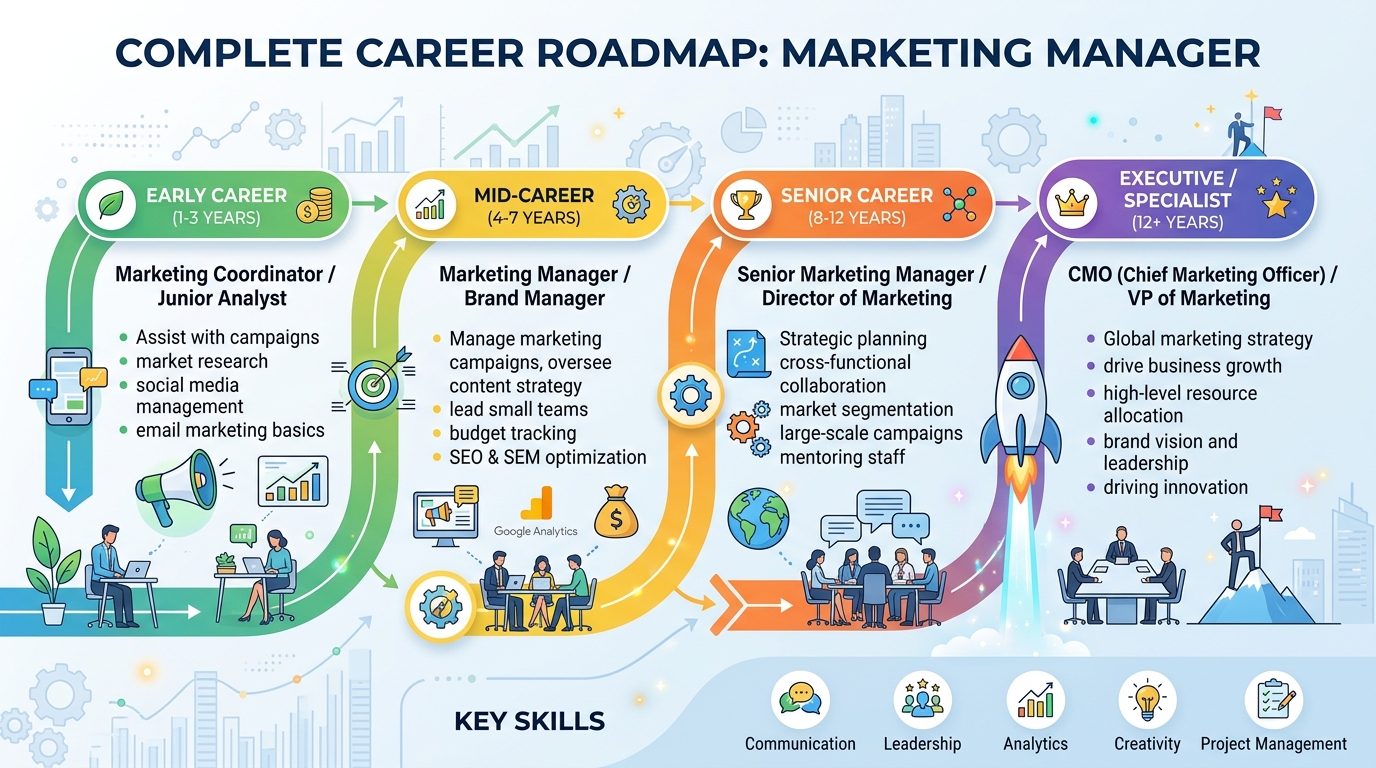
Career Growth Path
- Marketing Intern
- Marketing Assistant
- Marketing Executive
- Marketing Specialist
- Senior Marketing Executive
- Marketing Manager
- Senior Marketing Manager
- Marketing Director
- Vice President of Marketing
- Chief Marketing Officer (CMO)
Professional Certifications
- Google Digital Marketing Certification
- Google Analytics Certification
- HubSpot Content Marketing Certification
- Meta Certified Digital Marketing Associate
- SEMrush SEO Certification
- Hootsuite Social Media Certification
- LinkedIn Marketing Certification
- Certified Marketing Management Professional (CMMP)
Challenges Faced by Marketing Managers
- Managing marketing budgets effectively
- Keeping up with changing consumer trends
- Meeting sales and revenue targets
- Handling intense market competition
- Managing multiple campaigns simultaneously
- Adapting to new technologies and platforms
- Measuring campaign effectiveness accurately
Future of Marketing Management
The future of marketing management is highly promising as businesses increasingly rely on digital channels to connect with customers. Emerging technologies such as Artificial Intelligence (AI), Marketing Automation, Big Data Analytics, Customer Personalization, Voice Search, and Predictive Marketing are transforming the industry.
Marketing managers who understand data-driven decision-making, digital platforms, and customer experience strategies will remain highly valuable in the evolving business landscape.
As organizations continue to invest in brand development, customer acquisition, and digital transformation, the demand for skilled marketing leaders is expected to remain strong for many years.
Tips for Becoming a Successful Marketing Manager
- Develop strong communication skills
- Learn digital marketing fundamentals
- Master data analysis techniques
- Stay updated with industry trends
- Understand customer psychology
- Build leadership abilities
- Learn project management skills
- Gain hands-on campaign experience
- Earn professional certifications
- Continuously improve strategic thinking
Conclusion
Marketing Management is a rewarding and influential profession that plays a critical role in organizational success. Marketing managers help businesses build strong brands, attract customers, increase revenue, and maintain competitive advantages in rapidly changing markets.
With strong career growth opportunities, attractive salaries, leadership potential, and increasing demand across industries, Marketing Management remains one of the most exciting career paths in the modern business world. By developing the right combination of marketing knowledge, analytical skills, creativity, and leadership abilities, aspiring professionals can build highly successful careers as Marketing Managers.